

Kemi Badenoch has helped us identify some of the ways in which politicians have contributed to our economic malaise. Unfortunately for her, she has done so inadvertently. That’s my reading of her attempt to offer a coherent vision of conservatism in her paper, The Right Way.
She writes:
[Governments] have taxed, regulated and directed the economy without taking proper account of the unintended consequences of their decisions: the jobs that are never offered or the investment that goes abroad. Businesses decide not to expand, ideas never make it to market, and the result is an economy carrying a heavier tax burden, more debt, more laws, but no growth.
She does not, however, provide convincing evidence for this. The claim that regulation prevents job creation runs into the fact that our employment rate is now actually higher than it was throughout the less regulated Thatcher years. Granted, some of these jobs are the wrong ones, but if you think this is simply because of HR managers or diversity and inclusion coordinators you are gravely mistaken.
A big example Badenoch gives is also unconvincing. She writes that since 1997 UK pension funds’ holdings of UK equities have slumped “because a culture of risk aversion was inadvertently built into regulations” with the result that “growing companies remain starved of capital.”
If this were the case, one would expect that equity prices and valuations would have fallen. But they’ve not. The dividend yield on the All-share index is now 3.1%, which is pretty much exactly what it was in the mid-90s. And since then, the index has risen by 3.8% a year on average - very close to the 4.1% per year rise in nominal GDP. These numbers suggest no great loss of appetite for UK equities.
Which is unsurprising. Finance is globalized. Foreign investors have stepped into the gap left by UK ones, thereby sustaining equity valuations and suppressing the cost of equity finance. You cannot think of regulation as if the UK were a closed economy.
This is true in another way, as Dan Davies has pointed out:
The UK is a great place to introduce new technologies or products, because we’re a big enough market to be economically viable, and we are generally trusted enough that an authorisation in the UK is an important data point to take to other regulators. So you launch in Britain, do your testing here, iron out your regulatory kinks, and then go to the EU and USA with a full package of test data and the imprimatur of a widely trusted partner. If we make “licensed in the UK” a global brand, then the investment will follow; people will want to develop technologies in proximity to the regulators who are approving them.
To put this at an extreme, if we had no regulations, products developed here could not be exported as they’d fail EU and US regulations. What matters is that regulation be intelligent, quick and flexible, not that it cease to exist.
Nevertheless, Badenoch’s example poses the question: why has capital investment been so low? (It’s grown by only 1.3% per year over the last ten years.)
The stock market has little to do with it simply because it has never really been a big source of finance for capital investment. Investment has instead been funded by banks, venture capital, internal funds and so on. Complaints about how well these do their job long pre-date debates about over-regulation: the phrase “Macmillan gap” was coined in the 1930s. Whether this is because of the institutional and cultural peculiarities of UK capitalism or because financiers have a more realistic assessment of investment projects than entrepreneurs is questionable. But there’s no reason to suppose that the problem is unusually bad now: certainly, Badenoch gives us no evidence on this.
Which brings us to another of Badenoch’s blind spots - to the possibility that capital spending has been low simply because capitalism has lost its underlying dynamism - a dynamism which in truth was only ever short-lived. You don’t need to be a Marxist to believe this: 20 years ago Fed chairman Ben Bernanke spoke of a “dearth of domestic investment opportunities” across the western world, a fact which remains the case today outside of AI capital spending. Just as Rachel Reeves was wrong to think that policy stability would unleash growth, so too might Badenoch be wrong to believe deregulation will do so. Both are victims of what I’ve called “Scooby Doo ideology” - the idea that the economy would have succeeded were it not for those meddling kids. If regulation has unintended consequences, then so too might deregulation.
This dearth of investment opportunities leads us to another problem with Badenoch’s analysis. “The state has normalised persistent borrowing” she says. But she doesn’t ask whether government borrowing is cause or effect. Such borrowing is by definition the counterpart to the net saving of the overseas and UK private sectors. But which drives which? If we are, as Badenoch claims, “awash with savings”, might it be that the latter is causing government borrowing?
One big fact suggests so. It’s that from the mid-90s until 2022 real gilt yields trended downwards even during times of big government borrowing. And even today the ten-year index-linked yield is lower than it was during the last two occasions when the government ran a surplus: 1988-90 and 1999-01. This is not consistent with government borrowing being exogenous and crowding out private sector investment. But it is consistent with it being the result of an (incipient) excess of private sector savings and dearth of investment opportunities.
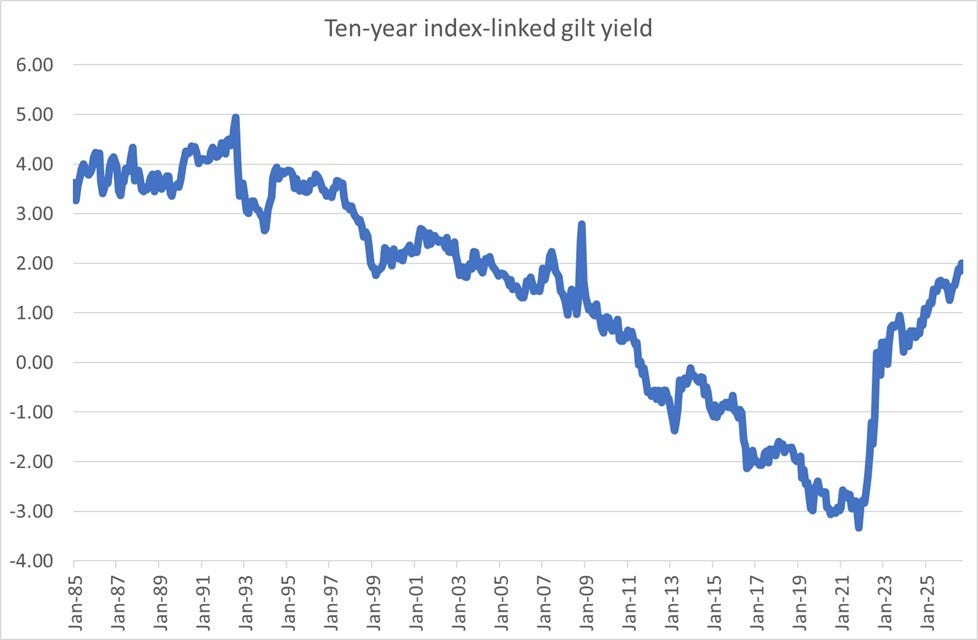
Badenoch, however, does not even consider this possibility.
Perhaps, thought, we can forgive her for not doing so. One element of politicians’ professional deformation is a tendency to exaggerate the agency of governments and under-estimate the extent to which they respond to emergent trends - in this case the investment dearth.
Which brings us to another of Badenoch’s blindspots - a lack of awareness of how to create the conditions in which deregulation would be feasible and sustainable. She says:
If people stop trusting one another, every transaction needs more oversight, more regulations, more lawyers.
She’s right. If you want to deregulate you need more trust. But how to create this? It would be naive to hope that rolling back the state would somehow lead to a revival of strong professional and business ethics: you can’t put the toothpaste back in the tube (especially if it wasn’t there in the first place).
We need something else that Badenoch doesn’t mention - more equality of bargaining power. If people can protect themselves we need less regulation. Philippe Aghion and colleagues have shown that strong unions are often associated with less government regulation; it’s no accident that the decline of British unions led to a rise in regulation. Nor is it an accident that many of the countries that score highest on the Heritage Foundation’s index of economic freedom are relatively egalitarian ones; Switzerland, Ireland, Australia, the Netherlands, Sweden and Denmark (to name a few) have both a higher ranking and less inequality than the US.
This points to a different way to deregulate - to inform and empower consumers. Just as we have GPs to advise us which medicines to take, so perhaps we need advisors and advocates to help us buy investment products, insurance, phones, broadband and so on. Such groups would help reduce our often-justified distrust of companies and so facilitate deregulation; they, rather than regulators, would protect us from predatory capitalists.
Badenoch never raises this possibility. She’s trapped in a mindset that sees politics as what governments do to (or for) people - as (in Julian Le Grand’s metaphor) knights rescuing pawns. She says that “government needs to create the conditions for growth” without seeing that these conditions require more than pulling policy levers: they require cultivating an ecosystem of countervailing powers in which a market economy can work for everyone.
Badenoch’s diagnosis, then, contains many blindspots: the degree to which governments operate in a globalized economy; the extent to which capitalist growth has endogenously slowed and investment opportunities diminished; the possibility that policies such as government borrowing are effect not cause; and the fact that policy isn’t about pulling levers but encouraging thriving ecosystems, a big element of which must be the empowering of customers and workers.
But here’s the thing. These flaws are not confined to her, or even merely to the Tory party; we see them in the Labour party too. I’m not sure this is simply because politicians lack brain-power. It might rather be that they, like all professionals, suffer from a form of professional deformation. Or it might be that they are working in the interests of extractive capital. Whatever it is, Badenoch’s ideas are no solution to capitalist stagnation.
I think the answer is in your piece. Politicians can't accept how little agency they have because it would look defeatist to the public. I thought this about both Burnham and Badenoch's speeches. Both massively overplayed the impact their ideas would have on the economy. Which then does harm public trust because the change never comes....
I've said this before: Why is Chris not advising government? The clarity with which he questiond the prevailing economic fashion is fantastic.
I've never been a Tory voter, but I think part of the collapse of the centre-right across Europe is they keep trying to be Thatcherite tribute acts & austerity merchants, and quite rightly people now see through it (something something 40 years of stagnation something something).
Those is just the kind of economic model that should excite them - business & investment friendly, workers not shirkers, quality advice and a balancing of power.