
Stagnation: the norm
We need more than tinkering if we are to raise economic growth significantly.

“To understand the man you have to know what was happening in the world when he was twenty” said Napoleon. He was right - a fact which suggests many economists might be overconfident about how quickly the economy might grow even with the very best policies.
Most of us over the age of 40 were educated to take economic growth for granted. Of course, we knew recessions were inevitable from time to time, but these were dips in a rising trend of prosperity. Between 1945 and 2005 real GDP per person grew on average by 2.3% a year, which meant that a young adult earlier this century was three times better off than his grandparents were.
But, but ,but. Such growth was historically unusual. Before 1945 trend growth was usually below 1% a year. The industrial revolution was a miracle that lifted us out of abject poverty, but it was a slow process.
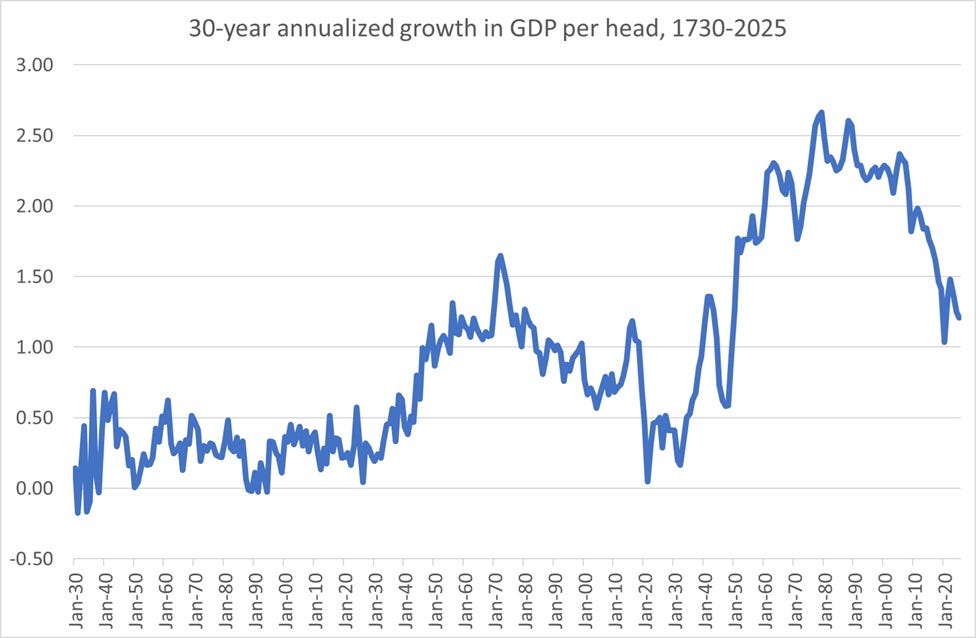
Our faith that 2%+ growth is achievable might therefore owe less to historic evidence and more to the psychological tendency to regard the age we grew up in as the normal one.
In fact, we have many reasons to think that low growth - verging on stagnation - is indeed the norm, especially for a moderately rich country.
Certainly, classical economists thought so. John Stuart Mill wrote in 1848:
It must always have been seen, more or less distinctly, by political economists, that the increase of wealth is not boundless; that at the end of what they term the progressive state lies the stationary state, that all progress in wealth is but a postponement of this, and that each step in advance is an approach to it.
For thinkers from Smith to Mill, economic growth was a race between diminishing returns and technical progress which would eventually be won by the former. “Eventually” might have arrived. We’ve picked much of the low-hanging fruit which means good ideas are harder to find. “Research productivity is declining sharply” found (pdf) Nick Bloom and colleagues, a finding corroborated (pdf) by Philipp Boeing and Paul Hunermund. What’s more, bosses have now learned the lesson (pdf) of William Nordhaus that companies capture only a “miniscule fraction of the social returns from technological advances”, and so are less incentivized to make them. Such slower technical progress cannot be offset by faster capital accumulation, given that we need a heck of a lot of it to raise output even by a little.
This tendency is exacerbated by another, pointed out by Dietrich Vollrath in Fully Grown. All economies shift from manufacturing to services as they mature, and this alone would reduce aggregate growth simply because it’s harder to make productivity gains in services than manufacturing.
There’s another reason why economic growth is slow. It requires labour and capital to move from less productive uses to more productive ones. And this change is necessarily slow simply because people take time to adjust; take time to learn of new opportunities or to gain new skills; and need time to not only install capital but to learn how best to use it. These reasons lay behind slow growth in the 18th and 19th centuries. Yes, there were some very dynamic industries but these were small and so their growth added little to aggregate growth: whist the 883,000 people working in the textiles industry in 1841 were becoming more productive, the 1.2 million in domestic service were not.
If AI is anything like all preceding technologies, this will be true of it too. Whilst there’s early evidence that productivity is rising in AI-producing sectors, there’s so far less evidence of it doing so in AI-using ones. That’s consistent with what we saw of other general purpose technologies such as steam power and electricity; it takes many years for them to greatly raise output.
On top of these technical forces there is also a cluster of social forces restraining growth. Joel Mokyr has written:
Technological creativity is a delicate and fragile flower that needs just the right institutional environment to thrive. Yet in a truly dialectical manner, its very success usually destroys the environment it needs to survive.
A prosperous society is one in which there are many people who are content with their lot and who don’t want to jeopardise it with the creative destruction that is economic growth. And so “the forces of conservatism” writes Mokyr “manage through a variety of legal and institutional channels to slow down and if possible stop technological creativity altogether.”
Some of these forces are company bosses themselves who focus on entrenching their incumbent power by buying out potential rivals, aggressively protecting their intellectual property or lobbying for favourable regulation. Managing a growing company is difficult because lots can go wrong (which is why growth stocks have traditionally been overvalued by investors) so why bother when you can opt for the quiet life instead?
As Joseph Schumpeter wrote, managers in big companies tend to be “rationalist and unheroic” bureaucrats rather than entrepreneurs, and lack the dynamism to drive growth.
But it’s not just bosses. There are also nimbys wanting to protect their house prices, a financial sector that benefits from the low real interest rates caused by stagnation, or lawyers and accountants who oppose tax simplification.
How can these people wield so much power against the wider public interest in raising growth? The answer lies in a point made by Mancur Olson in The Rise and Decline of Nations. Small groups find it easier to coordinate than large ones, and so pressure groups form among sectional interests rather than among larger dispersed interests. That leads to lobbying for special favours, protection and tax breaks, all of which accumulate over time to clog up the economy. Meanwhile, the dispersed interests in the sort of things that might raise growth - competitive markets, a simple tax system, more efficient procurement and infrastructure spending - do not organize themselves into lobbying groups and so don’t get a look in.
Maybe, therefore, we should regard stagnation as the norm, even before we think about other forces suppressing growth such as climate change, inequality or an ageing population.
None of this is at all radical. I’ve cited only mainstream thinkers, and I’m ignoring the possibility that inequalities of wealth and power hold back growth, or Marx’s idea that:
At a certain stage of development, the material productive forces of society come into conflict with the existing relations of production or – this merely expresses the same thing in legal terms – with the property relations within the framework of which they have operated hitherto. From forms of development of the productive forces these relations turn into their fetters.
Instead, the point is that pessimism about economic growth, especially in mature economies, is a strong intellectual tradition. Conversely, optimism might be based less upon evidence and more upon the accident of our upbringing. After WWII there was a concatenation of circumstances uniquely favourable to fast growth: a backlog of civilian innovations; a need to rebuild housing and physical capital; declining trade barriers; an absence of major financial crises until 1973; strong wage growth encouraging capital-labour substitution and (perhaps) a confidence that aggregate demand would remain high thereby justifying big capital spending. These circumstances, though, were only temporary. But because we happen to have been born into them, we assume them to be normal. Which they were not.
Now, you might reply here that the UK’s economic performance is so bad that it should be easy to improve it simply by learning from overseas best practice. We don’t need clever ideas; we simply need to stop doing stupid shit.
What this misses, however, is that “stupid shit” is endogenous. The political obstacles to intelligent policy-making are themselves rooted in economics. Stagnation has fuelled a reactionary backlash against liberal migration, funding of universities and membership of the single market. Our economic maturity has created powerful “forces of conservatism” opposed to economic change. And the collective action problem means that sectional interests defeat the general interest.
We can draw two possible inferences from this. One would be to learn to live with stagnation, which means finding some way of beating the far right, the rise of which is itself a symptom of stagnation. The other is to recognise that restoring economic growth requires some very radical changes, if only to create the conditions in which sensible technocratic policy-making is even possible. What is clear, though, is that centrist tinkering isn’t enough.
I'm becoming a big fan, Chris. Your essays on economics cover topics and analyses I simply don't find elsewhere. Keep it up!
"The earliest attribution to Napoleon known ... appeared in 1998. Yet, the Emperor died in 1821. The long delay means that the linkage to Napoleon currently has no substantive support."
https://quoteinvestigator.com/2022/11/07/age-twenty/